Ariège is the historical heartland of Catharism, the medieval religious movement whose tragic persecution left a permanent mark on the landscape and collective memory of southern France. From the vertiginous peaks of Montségur to the lanes of Foix, from the gorges of the Ariège river to the high plateaux of Sault, every stone tells the story of the Cathars — dissenting Christians who defied the Roman Church for more than a century before being crushed. From Domaine de la Trille, located at Sainte-Foi near Mirepoix, the major Cathar sites are reachable in about an hour's drive.
Who Were the Cathars? A Religion of Light and Dualism
The word "Cathar" comes from the Greek katharos, meaning "pure". The Cathars — who called themselves "Bonshommes" (Good Men) or "Bonnes Femmes" (Good Women) — were Christians who professed a dualistic vision of the world: God, the principle of light and goodness, had created souls; the material world was the devil's work, a trap from which souls had to be freed through the "consolament", the central Cathar sacrament. They rejected Catholic sacraments, the church hierarchy, clerical wealth and the violence of war. Their irreproachable morality and frugal lifestyle earned them considerable popularity in southern France, especially in Languedoc and Ariège, where the local nobility offered them protection.
Cathar society distinguished between the "parfaits" (Perfects — men and women), the clergy of the religion who had received the consolament and lived in total asceticism (no meat, no sexual relations, an itinerant life), and the "croyants" (believers), the mass of the faithful who led ordinary lives and hoped to receive the consolament on their deathbed. This decentralised organisation, suited to rural communities, explains the depth of its roots in Ariège villages.
Did you know? The Register of inquisitor Jacques Fournier (future Pope Benedict XII), compiled between 1318 and 1325 concerning the village of Montaillou in Ariège, is one of the most extraordinary sources on medieval life. The historian Emmanuel Le Roy Ladurie drew on it for his celebrated book "Montaillou, village occitan".
The Albigensian Crusade and Persecution (1209–1244)
In 1209, Pope Innocent III preached a crusade against the Cathars, who were at times called "Albigensians" after the city of Albi. The northern armies, commanded by Simon de Montfort, ravaged Languedoc for decades, massacring Catholics and Cathars indiscriminately. The infamous "Kill them all, God will know his own" is said to have been uttered at the sacking of Béziers in 1209. Ariège became a refuge for survivors: its mountains, caves and defiant lords offered a last terrain of resistance.
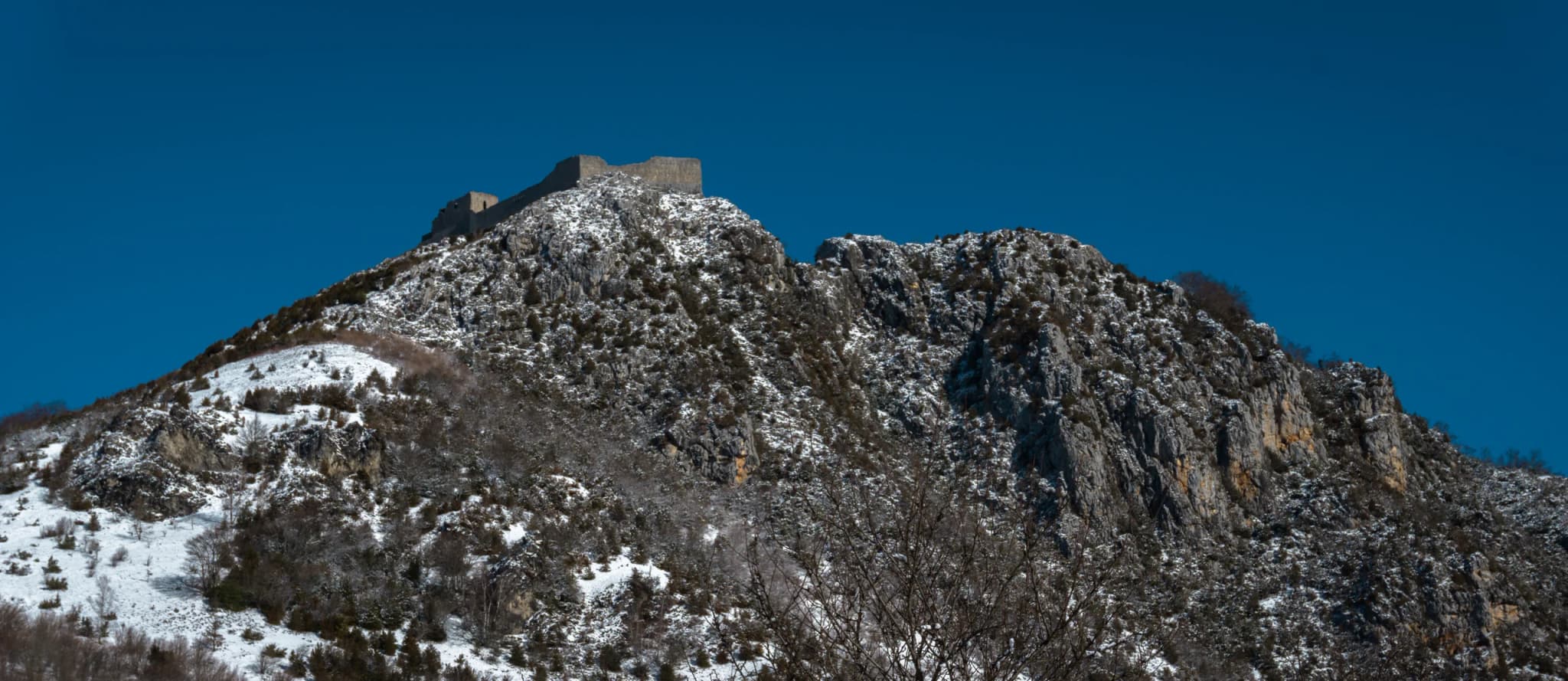
The fall of the castle of Montségur in March 1244 marked the fatal turning point. After a ten-month siege, the last Cathar Perfects — more than 200 people — refused to recant and were burned alive at the foot of the pog, in a field since named "le camp des Cremats" (the Field of the Burned). This tragic event has remained in the collective memory as the symbol of a people exterminated for their beliefs.
Montségur: The Sacred Pog of the Cathars (about 30 min from the Domaine)
About 30 minutes from Domaine de la Trille, Montségur is the most emotionally charged site in all of Cathar Country. The current castle, built by the French after 1244 on the ruins of the Cathar fortress, stands at 1,207 metres altitude. The walk up from the car park (allow 30–40 minutes) is accessible to all but requires a basic level of fitness. At the summit, the ruins of the keep and ramparts offer a 360-degree panorama over the Pyrenees and Ariège forests.
- Access: paid car park in the village, walk up on foot (30–40 min), sturdy shoes recommended
- Catharism Museum in the village: an excellent introduction to the history, open in season
- The Camp des Cremats: commemorative stele at the foot of the pog, a place of quiet reflection
- Orientation: views of Pic des Trois Seigneurs, the Benaure valley and the high Pyrenees
- Tips: avoid the hottest hours in summer, bring water, come early or in the late afternoon
Roquefixade: Romantic Ruins Facing Montségur (about 25 min)
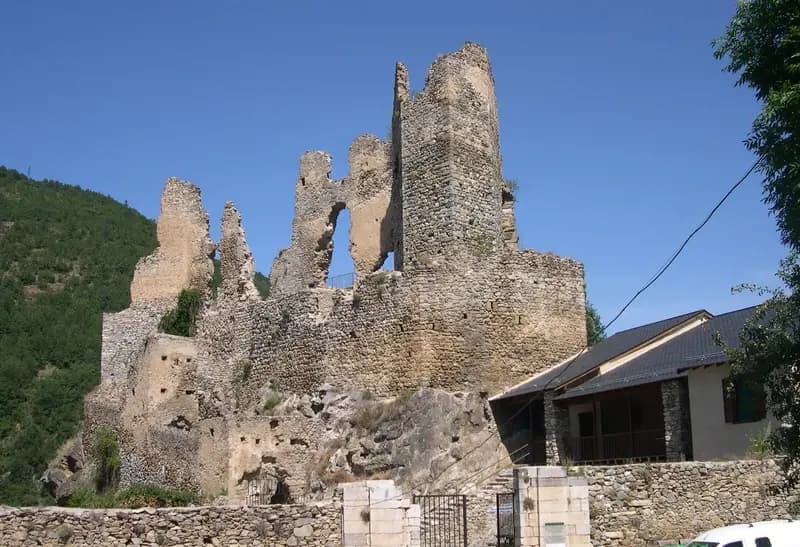
About 25 minutes from the Domaine, the castle of Roquefixade occupies a spectacular site above the village of the same name. Less visited than Montségur, it offers free and open access via a 20-minute path. From the ruins of the ramparts, the view of Montségur castle in the distance, on the other side of the valley, is striking: the two fortresses face each other like twin sentinels of Cathar resistance. The site is particularly well suited to family walks at sunset.
Foix, Puivert and Other Medieval Strongholds
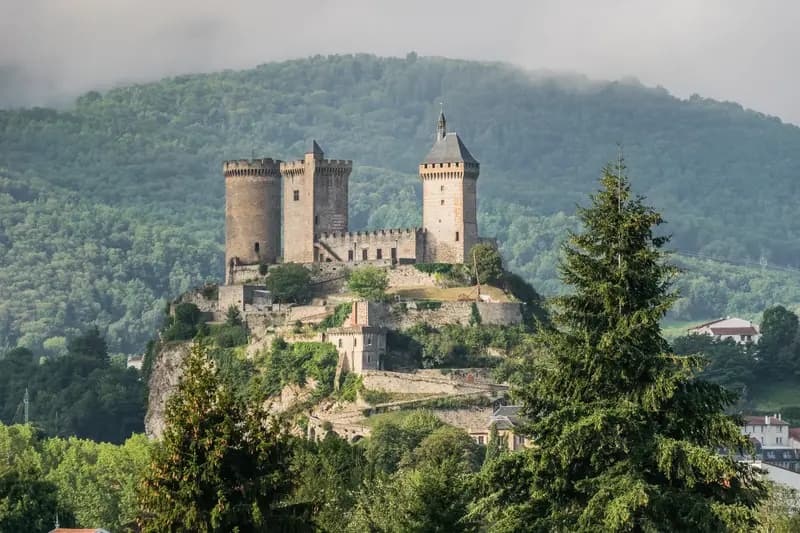
The castle of Foix (about 30 min), with its three distinctive towers dominating the town, is closely linked to Cathar history: the counts of Foix were among the principal protectors of the Cathars. Its interactive medieval museum is ideal for families. Further east, the castle of Puivert (about 45 min) is one of the best preserved in the region. Unlike purely military citadels, Puivert was a noble residence: its musicians' hall with sculpted capitals depicting medieval instruments is unique in Europe. It was a centre of troubadour culture, intimately connected to the Occitan Cathar world.
Museums and Interpretation Centres of Catharism
- Musée du Catharisme de Montségur: permanent exhibition on the life and persecution of the Cathars, visit before climbing to the castle
- Châteaux de Lastours (about 1h30): four Cathar castles in a spectacular setting
- Musée de Tarascon-sur-Ariège: regional archaeological collections including the medieval context
- Musée de Foix: inside the castle, interactive and child-friendly
Occitan Ariège: A Living Cultural Identity
Beyond the castles, the Cathar Country is also a cultural and linguistic identity: Occitan, the language of the troubadours and the Cathars, remains present in Ariège. Place names, local expressions, cuisine and popular festivals bear witness to this distinct civilisation that the crusade tried to erase. Today, active associations work to transmit the Occitan language and culture. Some local producers still name their products in Occitan — a delightful way of keeping this memory alive.
Our suggestion: begin your Cathar immersion at the Montségur museum (1h), then climb to the castle (1h round trip). In the afternoon, head to Roquefixade to contemplate Montségur from afar at sunset. The perfect programme from Domaine de la Trille in a single day.
Book your stay at Domaine de la Trille to explore Cathar Country. About 25 min from Roquefixade and about 30 min from Montségur. Caravans and gîtes from €90/night, 2-night minimum.
View availability