Montségur is far more than a castle. It is a symbol, a place of memory, a breathtaking natural site and an accessible hike that rewards every step with an increasingly awe-inspiring panorama. Perched at 1,207 metres altitude on its pog (rocky outcrop), the Château de Montségur dominates the Ariège landscape and carries within it one of the most tragic chapters of French medieval history.
The Cathar history of Montségur
At the beginning of the 13th century, Catharism was a powerful religious movement in southern France. Considered heretics by the Catholic Church, the Cathars were hunted by the Albigensian Crusade launched by Pope Innocent III in 1209. Montségur became the refuge of the last Cathar resistants. For more than ten years, the hilltop fortress held out against the assaults of the royal army.
In 1243, the army of the king of France and the troops of the Inquisition besieged Montségur with several thousand soldiers. The siege lasted ten months. In March 1244, after a negotiated surrender, more than 200 Cathars — men, women and "parfaits" — refused to renounce their faith and were burned alive at the foot of the pog, at the place now known as the "Prat dels Cremats" (the field of the burned). This date symbolically marks the end of organised Catharism.
The Montségur museum, in the village, presents archaeological objects found on the site and retraces the history of Catharism in an informative way. An essential complementary visit.
The hike to the castle: an accessible route
The climb to Château de Montségur is a short but sustained hike. From the car park at the foot of the pog (free), the path rises over approximately 1.5 km with an elevation gain of 200 metres. Allow 25 to 35 minutes for the ascent, depending on your pace. The path is well maintained with stone steps and handrails on the steepest sections. Natural resting points arise at the viewpoints that open up as you climb.
- Distance: approximately 1.5 km from the car park to the castle (one way)
- Elevation gain: approximately 200 metres
- Ascent time: 25 to 35 minutes
- Difficulty: easy to moderate, accessible to children from age 6–7
- Hiking or sports shoes recommended
- Avoid the ascent during the hottest hours in summer
- Bring water — no refreshment point at the top
The panorama at the summit: breathtaking
At the summit, the reward is immense. The castle offers a 360-degree panoramic view over the Pyrénées, the Ariège plain and the foothills. On a clear day, you can make out the snow-capped peaks of the Pyrenean range, the Pic de Saint-Barthélemy, and the plain stretching to the horizon. The site is particularly beautiful at sunrise and sunset, when golden light bathes the walls and the mountain.
The castle itself, although partially in ruins, makes it possible to understand the layout of the fortress: the pentagonal keep, the curtain walls, the cistern and the living quarters. Explanatory panels recount the history of the site. Take time to walk the full circuit of the walls to enjoy all the viewpoints.
Practical information
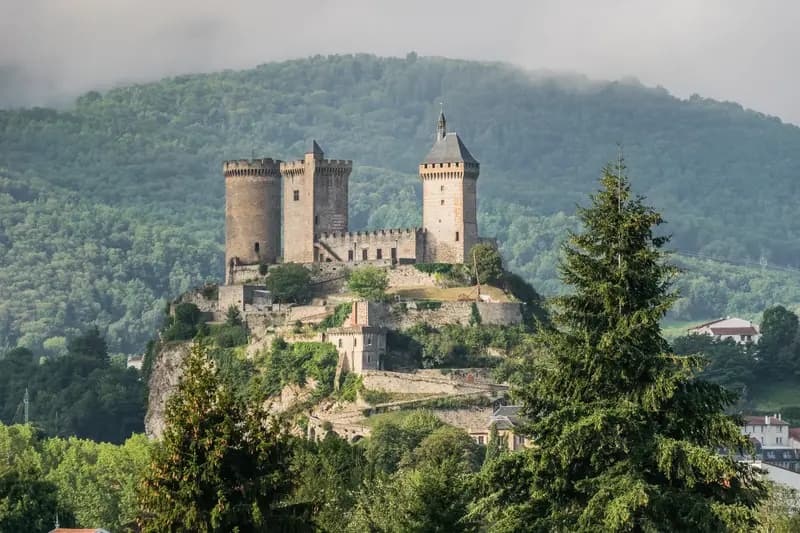
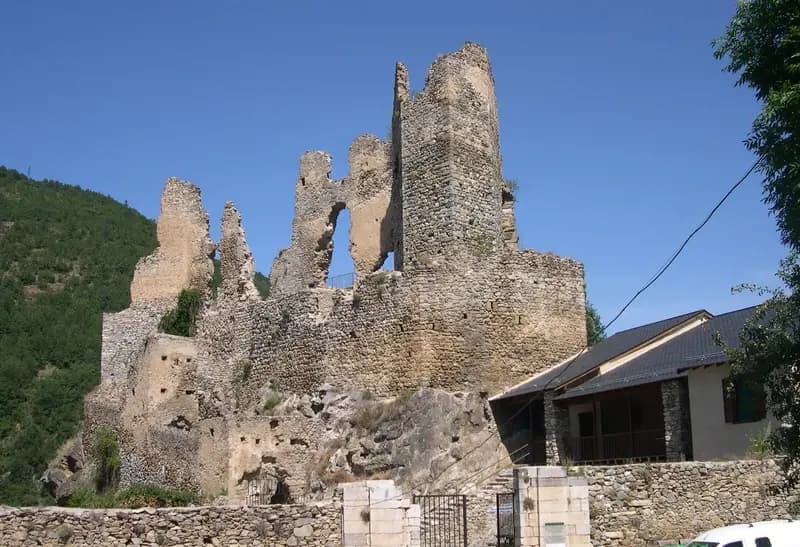
The Château de Montségur is approximately 30 minutes by car from Domaine de la Trille, along a pleasant road through the Ariège countryside. The village of Montségur has a few restaurants and shops. The visit can easily be combined with other Cathar sites in a single day: Roquefixade (25 minutes from the Domaine), the Château de Foix (30 minutes), or a stroll through the bastide of Mirepoix on the way back.
Tip: go up early in the morning or late in the afternoon to avoid the heat in summer and to enjoy the best light. Bring a windproof layer — the summit is often breezy even in fine weather.
Domaine de la Trille is 30 minutes from Montségur. Combine Cathar history with a farm stay. Roulottes and gîtes from €90/night, 2-night minimum.
View availability